Ownership and Management Information
1. General Information
Jurnal Ilmu Komputer dan Informatika (JIKI) is a peer-reviewed, open access scientific journal that publishes original research articles and review articles in computer science and informatics, with a particular focus on machine learning, data mining, and artificial intelligence. JIKI provides a forum for researchers, academics, and practitioners to share new methods, models, systems, empirical findings, and applications that advance computational and intelligent technologies.
| Item | Details |
|---|---|
| Journal Title | Jurnal Ilmu Komputer dan Informatika (JIKI) |
| Abbreviation | JIKI |
| P-ISSN / E-ISSN | 2807-6664 / 2807-6591 |
| DOI Prefix | 10.54082 (Crossref) |
| Publisher | CV Firmos Publishing |
| Frequency | Twice a year (June and December) |
| Peer Review | Double-blind peer review |
| Languages | English and Indonesian |
| Access Model | Open access |
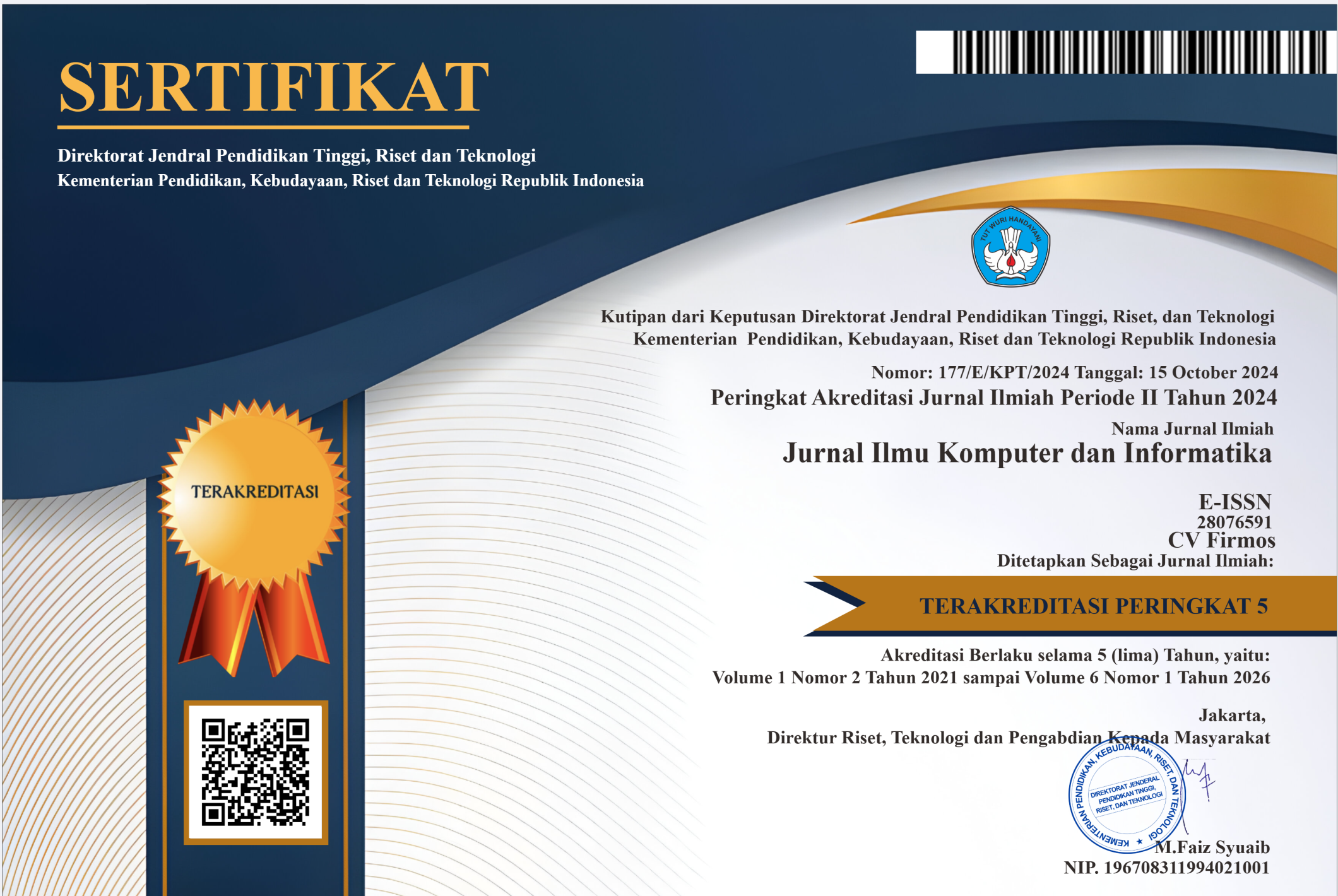
| Accreditation | SINTA 5 (Decree No. 177/E/KPT/2024) |
| Website | https://jiki.jurnal-id.com/ |
| Contact | jurnalidcom@gmail.com |
This page provides information about the ownership, publisher, and management of JIKI to ensure institutional transparency and to make clear who is responsible for operating, publishing, and managing the journal.
2. Journal Ownership
JIKI is owned by CV Firmos Publishing. The owner is responsible for the journal’s institutional sustainability and supports professional, sustainable, and ethical scholarly publishing. This includes providing infrastructure, resources, and long-term continuity for the journal.
Ownership does not limit the editors’ independence. Decisions to accept, revise, or reject manuscripts are based solely on:
- Relevance to the journal’s Focus and Scope.
- Scientific quality, originality, and methodological rigour.
- The outcome of peer review.
- Compliance with publication ethics.
3. Publisher
JIKI is published by CV Firmos Publishing, which is responsible for publishing support, technical infrastructure, and administrative management of the journal. This includes:
- Maintaining the online journal system.
- Registering DOIs with Crossref.
- Ensuring long-term archiving and preservation of published content.
- Supporting indexing and dissemination.
Publisher information:
- Name: CV Firmos Publishing
- Address: Serma Mukhlas Street, Karangtengah, Kecamatan Banjarnegara, Kabupaten Banjarnegara, Central Java, Indonesia. 53416.
- Email: jurnalidcom@gmail.com
This information is published on the journal website so that authors, readers, reviewers, and the academic community can easily find out who operates the journal.
4. Journal Management Structure
JIKI is managed by an editorial team and journal staff, each with clearly defined roles:
- Editor-in-Chief. Responsible for the journal’s editorial direction and policies, oversight of the editorial process, and final decisions on accepting or rejecting manuscripts.
- Section Editors / Associate Editors. Handle manuscripts within their areas of expertise (machine learning, data mining, and artificial intelligence). Their work includes initial screening, selecting and coordinating reviewers, evaluating revisions, and making editorial recommendations to the Editor-in-Chief.
- Editorial Board. Experts from various institutions who provide academic guidance, support the journal’s development, promote the journal within the research community, and help maintain the quality and scientific standards of published work.
- Reviewers. Independent experts who assess the originality, novelty, methodological soundness, experimental design, reproducibility, validity of results, and scientific contribution of submitted manuscripts.
- Copyeditors and Layout Editors. Ensure that accepted manuscripts meet the journal’s language, formatting, and presentation standards before publication.
- Journal Manager and Support Staff. Manage the journal system, publication administration, website content, DOI registration, indexing, and the smooth running of the editorial process within their authority.
The names, affiliations, and roles of the editorial team are listed on the Editorial Team page, and reviewers are listed on the Reviewers page. Where available, these pages include links to each member’s academic profile (e.g., ORCID, Scopus ID, Google Scholar, or SINTA). The composition of the editorial team is reviewed periodically and updated whenever changes occur.
5. Editorial Independence
JIKI is committed to protecting the independence of its editorial process. Editorial decisions are based on the scientific quality and relevance of manuscripts, their fit with the journal’s Focus and Scope, the results of peer review, and compliance with publication ethics.
The owner, publisher, sponsors, advertisers, and any other parties with institutional or commercial interests may not interfere improperly in editorial decisions. Editors have full authority to make decisions based on academic judgement and journal policy. Business considerations, including the payment of any publication fees, have no influence on editorial decisions.
Any conflict of interest that could affect peer review or editorial decisions must be disclosed and handled in accordance with the JIKI Conflict of Interest Policy.
6. Sources of Funding and Revenue
JIKI’s operations are supported by CV Firmos Publishing and Article Processing Charges (APCs). Information on any publication fees is set out on the Article Processing Charges page and is available to authors before they submit. Waivers or discounts, where offered, are granted independently of the editorial process.
7. Transparency and Accountability
JIKI provides accurate, clear, and accessible information about its ownership, publisher, management structure, editorial responsibilities, and funding sources. This information is updated whenever there are institutional changes, a change of publisher, or changes to the editorial team.
Through transparent ownership and management, JIKI supports professional, accountable, independent, and ethical scholarly publishing. It aims to ensure that every published article can be trusted by readers, authors, the research community, and the public.